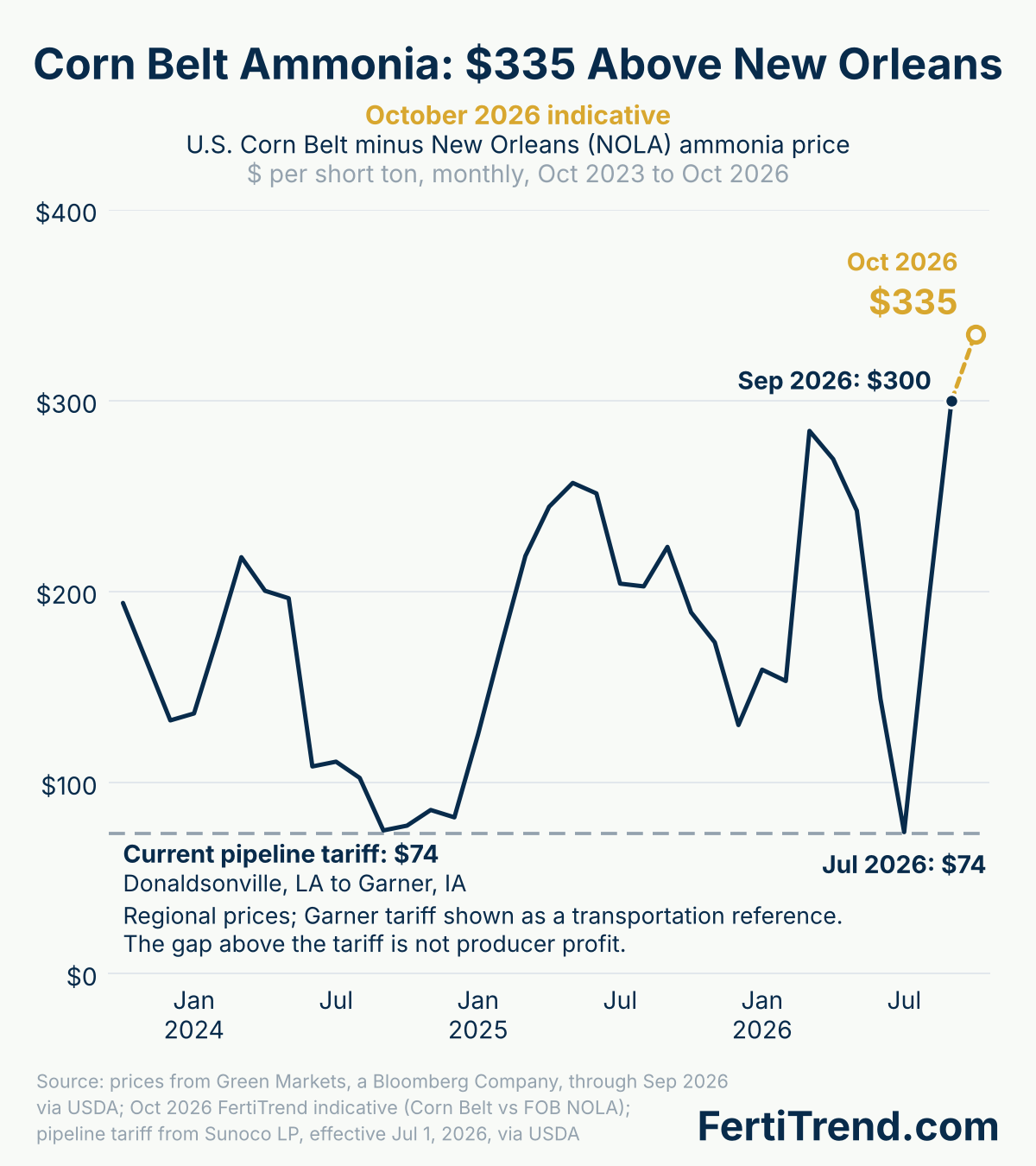
The premium widened from both directions
Between July and September, Corn Belt wholesale ammonia rose $111 per short ton while New Orleans fell $115. The regional premium widened from $74 to $300.
Roughly half the widening came from higher inland prices and half from lower Gulf prices. A supplier following the Gulf market alone would have seen a different price signal from a buyer replenishing inland inventory.
Those historical figures are regional averages from Green Markets, published through USDA. October’s $335 spread uses FertiTrend’s regional indication, rather than a quoted price at CF’s Garner terminal.
What Garner adds to the CF distribution network
CF’s Garner terminal can receive ammonia by pipeline from the Gulf Coast or by rail from its Medicine Hat plant in Alberta. The company also has the ability to export from the Gulf.
That creates two commercial choices: which source should supply an inland customer, and which destination offers the best return for an available ton.
Access can come through ownership, leases or commercial partnerships. What matters is having usable capacity, customer relationships and the rights to serve the market.
What the freight comparison shows
The published pipeline base tariff from Donaldsonville to Garner is $73.59 per short ton, or approximately $74.
I estimate Canadian rail freight at $185–190 per short ton, plus approximately $15 for tank cars. Garner provides a transportation example within the broader inland market:
| Route to Garner | Transportation cost per short ton |
|---|---|
| Donaldsonville by pipeline | About $74, published base tariff |
| Medicine Hat by rail | Estimated $200–205, including tank cars |
These transportation figures exclude terminal expenses, product losses, financing and other charges. They do not establish a Garner selling price or terminal netback.
The $335 regional premium is substantially larger than the $74 pipeline base tariff. That comparison helps explain why inland access matters. Determining a return requires an executable price at the terminal, the full cost of reaching it and comparable selling terms.
For Medicine Hat, the decision also depends on what a ton can earn at its other outlets. A NOLA quotation alone does not establish whether shipping Canadian ammonia to Iowa offers the best return.
The useful comparison is what each destination returns to the same origin after the costs of reaching it.
Lower gas costs are part of the sourcing decision
Lower gas costs at Medicine Hat help offset the higher rail bill, although Canadian supply can still have a higher delivered cost than Gulf product.
The cheapest modeled source and the best available source are not always the same. A Gulf ton may already be committed, have a better alternative customer or be unable to reach the inland market within the required delivery period. A second supply route gives CF another option when those conditions change.
Implications for suppliers and buyers
For international suppliers entering North America, the distribution plan helps determine which customers and prices are accessible. Inland terminal access belongs in the commercial strategy alongside the product sale.
The agreement matters as much as the physical route. Inventory funding, release rights, customer relationships and pricing terms determine who benefits from stronger inland values and who carries the associated costs and risks.
For U.S. wholesalers and retailers, the comparison extends beyond the purchase price to where inventory will be held and how it will be replenished. A second supplier adds practical flexibility when its product and transportation are available during the selling window.
Earlier inventory also brings financing, storage and price exposure. July’s outcome does not make summer fill an automatic winning strategy. The inland price rose $111 through September, while the regional premium widened $226. The wider premium is not the inventory holder’s gain.
The objective is to balance the cost of carrying product against the ability to serve customers when they need it.
Distribution belongs in the competitiveness comparison
October’s premium makes the value of inland access visible. A terminal still needs to earn its costs across changing seasons, spreads and throughput levels. Product committed under earlier sales agreements will also reflect those terms.
CF’s network gives it more ways to connect available supply with customers. Producers with fewer outlets have less flexibility when regional prices separate.
Production costs influence what a company spends to make ammonia. Its distribution network influences which markets, and ultimately which selling prices, it can access.
Sources and assumptions: Historical prices are Green Markets values published by USDA. October regional prices and Canadian rail and tank car costs are FertiTrend indications or estimates. Route information comes from CF Industries; the pipeline base tariff is published by Sunoco. Figures do not represent CF’s reported prices or profits.